
Refractive Procedures

Refractive procedures are specialised treatments designed to correct vision problems caused by refractive errors such as myopia, hyperopia and astigmatism. These procedures help improve the way light focuses on the retina, reducing dependence on glasses or contact lenses in suitable patients.
At Shree Hanumant Vision Care (SHVC), Varanasi, patients receive a comprehensive eye examination to evaluate their vision and determine suitable correction options. Depending on corneal thickness, eye health and refractive error, an ophthalmologist may recommend laser vision correction or other refractive procedures.
The treatment approach is personalised according to each patient’s visual needs and eye condition.
What Are Refractive Procedures?
Refractive procedures are eye treatments that correct refractive errors by changing the focusing ability of the eye. Some procedures reshape the cornea using laser technology, while others involve placing a specialised lens inside the eye.
These procedures are commonly considered by people who want to reduce their dependence on spectacles or contact lenses.
Common refractive errors include:
Myopia (Nearsightedness)
Hyperopia (Farsightedness)
Astigmatism
Presbyopia (Age-related near vision difficulty)
The suitable procedure depends on the patient’s eye examination and individual requirements.
Types of Refractive Procedures
Different refractive procedures are available to correct vision problems. The suitable option depends on your eye condition, corneal health and prescription.
LASIK Surgery
LASIK uses a specialised laser to reshape the cornea and correct certain refractive errors, helping improve vision and reduce dependence on glasses.
PRK Surgery
Photorefractive Keratectomy (PRK) is a surface laser procedure that reshapes the cornea to correct refractive errors without creating a corneal flap.
LASEK
LASEK is a surface-based laser vision correction technique that involves gently moving the outer corneal layer before reshaping the cornea.
Epi-LASIK
Epi-LASIK is a surface refractive procedure that separates the outer epithelial layer before laser reshaping of the cornea.
Phakic IOL (ICL)
Phakic IOL surgery involves placing an additional lens inside the eye to correct certain refractive errors while preserving the natural eye lens.
Symptoms of Refractive Errors
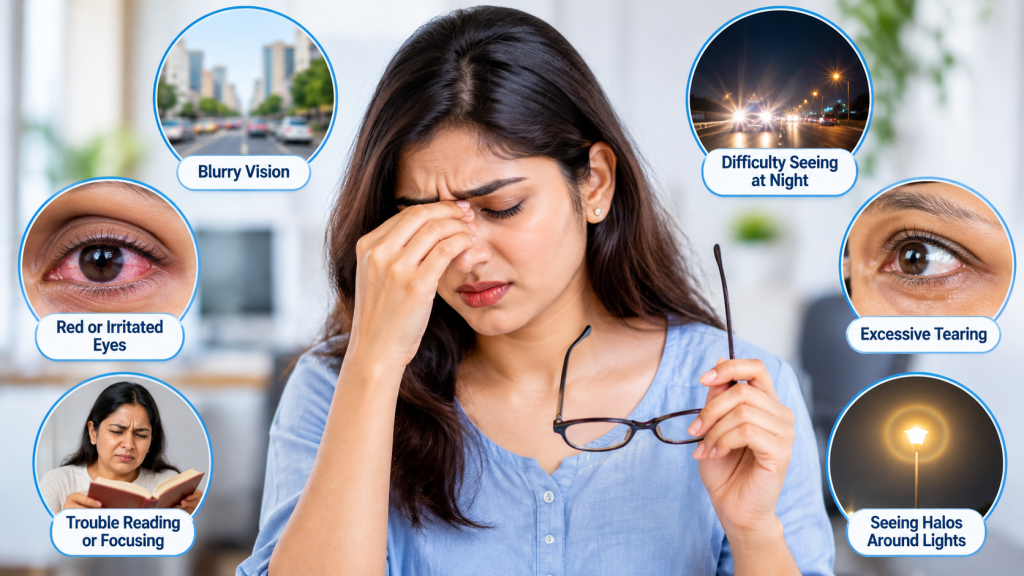
Refractive errors can affect everyday activities such as reading, driving, working and using digital devices.
Common symptoms include:
- Blurred or Distorted Vision
- Difficulty Seeing Distant Objects
- Difficulty Reading Nearby Objects
- Frequent Headaches
- Eye Strain and Fatigue
- Squinting to See Clearly
- Difficulty Seeing Clearly at Night
These symptoms may be associated with refractive errors, but an eye examination is necessary to identify the actual cause.
Causes and Risk Factors of Refractive Errors
Refractive errors occur when the shape or focusing power of the eye prevents light from focusing correctly on the retina.
Common causes and risk factors include:
- Eye Shape and Length: An eyeball that is longer or shorter than normal can affect how light focuses on the retina.
- Corneal Curvature: An irregular corneal shape can cause astigmatism and distorted vision.
- Genetic Factors: Family history can increase the likelihood of developing certain refractive errors.
- Age-Related Changes: Changes in the natural lens can cause presbyopia, making near vision more difficult.
- Changes in Lens Focusing Power: Variations in the eye’s natural lens can contribute to refractive errors.
How Are Refractive Errors Diagnosed?
A detailed eye examination helps determine the type and severity of refractive error and whether a patient is suitable for vision correction surgery.
Visual Acuity Test: Checks how clearly a person can see letters and objects at different distances.
Refraction Test: Determines the spectacle prescription and identifies myopia, hyperopia or astigmatism.
Corneal Topography: Creates a detailed map of the corneal surface to identify irregularities.
Corneal Pachymetry: Measures corneal thickness to assess suitability for laser procedures.
Slit-Lamp Examination: Evaluates the cornea, lens and other front structures of the eye.
Tear Film Evaluation: Checks tear quality and dry eye conditions that may influence treatment suitability.